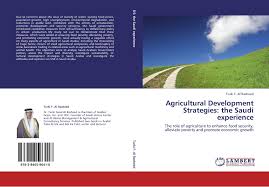
Agricultural Development Strategies in Saudi ArabiaDr. Turki Faisal Al Rasheed, Agricultural Development Strategies: the Saudi Experience, Lambert Academic Publishing, ISBN no. 978-8465-9641-8, paperback, 332 pages
An interesting book on Agriculture Development Strategies have published newly. Everybody thinks that Saudi Arabia is composed of deserts and she relies on food imports and has ony oil fields which are not enough for peoples’ future. But as we know that Saudi Arabia had some agricultural experience and she is one of the unknown producers of wheat. Everybody knows that poverty could be alleviated by supplying agricultural developments. Dr. Turki Faisal Al Rasheed who is an expert on agriculture argues that if there exists an agricultural strategy of Saudi Arabia or not by comparing his country with some others.His argument is that “agriculture can be a tool to enhance security, alleviate poverty and promote economic growth and it is applicable to all countries including Turkey, in fact according to my study Turkey ranked no. 5 out of 22 countries surveyed for the suitability of countries for Saudi Agricultural Investment Abroad.”
He states his aim of writing this book as follows: “My study set out to demonstrate that these measures, which were aimed at ensuring food security, alleviating poverty, and promoting economic growth, were actually having a negative effect on many aspects of agriculture in Saudi Arabia, including the downsizing of huge farms; closure of small agricultural companies; and bankruptcy of some businesses trading in related areas such as agricultural machinery and animal health. The objectives were to analyse Saudi Arabian Government policies, assess the impact and diversity, investigate sustainability, of cultural development strategies in Saudi Arabia and investigate the attitudes and opinions on CSR in Saudi Arabia.”( http://www.amazon.com , 17.01.2012)Here is the short summary of his book:
The government of Saudi Arabia has raised questions about the long-term prospects to food security, alleviating poverty and economic growth. The issues of scarcity of water, soaring food prices, population growth, high unemployment, environmental degradation, reductions in arable land combined with the effects of urbanization, economic development and security concerns have led to measures from self-sufficiency to deflationary policy in wheat production.
This book aims to show that there is no clear policy understanding of how deflationary policies will impact both the macro and micro levels. It will put forward both a theoretical framework and a practical analysis of the use and implementation of Agricultural Development Strategies (ADS) in Saudi Arabia. Furthermore, the aim of this research is to develop a conceptual framework to understand the role of agriculture in achieving sustainable development in Saudi Arabia. The research approach is deductive, aligned to the positivism philosophy. It will use a large-scale survey as the primary data, statistical data for the secondary data collection tool, and subsequent quantitative analysis techniques. The findings of this research will demonstrate the importance of developing water optimization schemes; establishing a national research and information Centre; using new technological innovation; and the need for agencies for marketing of agricultural products, taking into account government and private organizations CSR and Stakeholder interest for the development of ADS.
It will also become clear, through this grand conceptual framework, that the heterogeneity in agro-climatic environments implies that no single ADS can be applied in all the regions of Saudi Arabia in a uniform manner. It is also important to note that, whilst ADS may seem useful today, it may not be useful tomorrow; therefore, continuous awareness and monitoring is required to evaluate its effectiveness.Reviewed by Ali Murat Kurşun
Yorum Yap