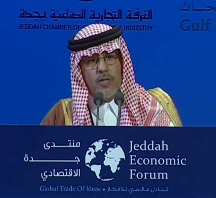
JEDDAH ECONOMIC FORUM “SPEECH”
Your Excellency,
Distinguish guest
Ladies and Gentlemen
Opening Remarks
Thank you Dr. Abdulaziz Sager, Chairman of the Gulf Research Center,
I am deeply honored to have this opportunity to take part in today’s session Food Security and Agriculture.
I am delighted to be back to Jeddah Economic Forum after 10 years of absence.
The topic of my speech is the “Role of Agriculture to enhance food security, promote economic growth and alleviate poverty”
I have prepared a long speech to deliver, fully supported with all the figures and facts.
However, what all has been said from all the distinguish speakers, I have chosen to cut my speech.
To summarize of what has been said.
-
Food shortages in Asia-Pacific region contributed to soaring food prices.
-
Governments are concerned that as population growth increases, high unemployment, arable land reductions, combined with effects of urbanization, economic growth and food security may emerge as one of the key issues of the 21st century.
-
Water Scarcity in Saudi Arabia is one of the limiting factors to local food production. Cereal grains have to be imported to compensate for the water deficit. Water consumption in Saudi Arabia in 2007was estimated at 23 billion cubic meters of which 20 billion cubic meters consumed for agricultural purposes, accounting to 87.5% of total water consumption. Water average 71%
-
Food security means that food is available at all times, that all persons have means of access to it; that is nutritionally adequate (enough) in terms of quantity, quality and variety; and that it is acceptable within the given culture.
-
Food security is the political aspect of agriculture development.
-
Agriculture is one of the most effective tools to promote growth and alleviate poverty. To highlight the neglect of agriculture development we take an example: the World Bank in 1980 lending was 25% loan to agriculture project. In the year 2000 the number went down to 10% only. Moreover, the bank has lost almost half of its technical staff in the area of agriculture development.
-
Economic development is a sustainable boost in the standards of living of the people of the country. It implies an increase in the per capita income of every citizen. It also leads to creation of more opportunities in the sectors of education, healthcare, employment and the conservation of the environment.
Conclusions
-
The world and the World Bank have forgotten just how important food and agriculture is.
-
The industrial world is operating at 60 to 70% of the capacity unfortunately, Agriculture, now operating full capacity.
-
Food security is not only about food, but it is all about security. Chronic hunger threatens individuals, governments, societies, and borders.
-
Achieving food security needs policy and investment reforms on multiple dimensions.
Three Million Saudis are below the poverty Line. The annual report of the Saudi Ministry for Social Affairs states that three million residents of the country are living below the poverty line.
Turki Faisal Al Rasheed, Chairman of Golden Grass Inc., pointed out that food security is the political aspect of agricultural development which is in turn one of the most effective tools to alleviate poverty. The World Bank now gives less credits to agriculture and has less specialized staff for agriculture than in the past. “The world and the World Bank have forgotten how important agriculture is,” Mr. Turki said. Agriculture is now operating at full capacity, while other parts of the world economy operate at only 60 percent capacity, this could develop into an issue. He hinted that agricultural investments abroad can be tricky and stated that he has been a “failed investor” in Sudan since 1982 and in Egypt since 1992. Land ownership in Sudan is difficult, he said, while Egypt has taxed developed land as such, without taking into consideration the costs of developing it and taxing it as undeveloped land as initially promised. Saudi Arabia should own the land together with a private partner in Sudan or Egypt as this would give the local partner a stake in the project and provide it some protection against arbitrariness.