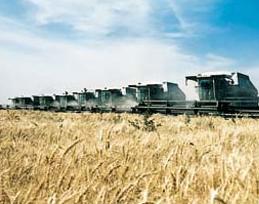
Farming a costly venture
Saudi Business – March 12, 1984
The problem of wheat farmers differ from those of the greenhouses. Their business had a flying start and still continue to fetch them attractive returns. While the incentives offered by the government triggered a production boom. There is an underlying fear in the industry that some of the incentives could be whittled down as the Kingdom attains self-sufficiency in wheat production. “Wheat is a high risk business. So I need to be protected and allowed to make some profit to stay in business. But if I am ask to produced at the international price as reported in the Arab press, I will be out of business in not time,” Saudi one wheat farmer.
Despite the air uncertainty about the future, agricultural firms find themselves, for the moment, solvent, This is especially with the wheat business, where each ton of wheat sold to the Grain Silos and Flour Mills Organization fetches a price of $1,000 (SR 3,500) against the imported wheat price of $200 to $300 per ton. “Whenever I tell the Americans about the wheat price in the Kingdom, they go crazy” observes Turki Faisal Rasheed, Chairman of Golden Grass, Inc.
Now in its second year, the company began with 36 American experts to help it out with farm development, management and contracting. It owns two wheat farms in Hail in the central province, one of which comprises 2,000 hectares. This farm, which is expected to produce 5,000 tons of wheat in the next season, is being irrigated by 20 center pivots. This is aside from a group of eight other farm in the region which the company will manage under various contracts.
Another area of operation which includes contracting. This has enabled it to equip farms in the Qasim and Al Kharj regions with center pivots and pumps and to undertake plant tissue and soil analysis on their behalf. “We also supply agrochemicals, including micronutrients and trace elements. We have been dealing mostly with suppliers from Britain , West Germany, and the United States, but our suppliers come mainly from Britain. Where the rates are competitive” says Rasheed.
Apart from the import of fertilizers and irrigation equipment, the main factor which makes farming a costly venture, according to Rasheed , is th e digging of wells. ” In Saudi Arabia we have to go very deep for water –from 500 meters downward. That’s very costly. And that’s were most of the money goes. In the United States, on the other hand, they strike water at a depth of about 300 feet or so. In the Hail region, we had to go 500 meters deep to get the water at the rate of 1,000 gallons per minute. This makes all the difference.
Another cost component is the import of labor. In the United States, says Rasheed, a farmer can be hired for $ 1,500 per month. But here he has to be paid double the salary, plus round trip airfare to enable him to go on vacation every six months. “Then they want a car transportation and other allowances. That’s is why I have sent away most of my American staff and brought in Filipinos. I have not only saved the staff salary , but the productivity has also improved. For example, the Americans used to take 4 days to install a 45-meter-long center pivot for irrigating a 50 hectare farm. Now the same job is being done by Filipinos in three and a half day at one-tenth their salary.
Whether it is American employees or those of other nationalities, expatriate labor is something which farmers cannot do without. As Rasheed points out, the farmer here in the Kingdom is till not exposed to modern techniques in the field. ” He is not familiar with the operations of the center pivot irrigation system and has to rely on the skilled manpower for his day-to-day work.”
It is because of the inadequate exposure to modern concepts in farming, he adds, that farmers here are sometimes taken advantage of by exporters. As an example, he refers to the center pivot system which comes in two designs- the bow string and the Warren truss. Basically, these are the patterns in which the center pivots irrigates the farm. In the former, the sprinklers are arranged in the shape of a bow string; in the latter, they are fitted on a bar that extends across the field. Each system has its strong and weak points which only a discriminating farmer knows. But farmers schooled in the traditional methods could easily be misled. Rasheed adds.
It is to protect farmers against trickery and fraud, Rasheed says, that the government has adopted regulations concerning the import of seeds, fertilizers, and agricultural equipment. “Three years ago, the import of just about any kind of seeds or fertilizers, are allowed. As a result, a cheap and substandard stuff was coming in. Similarly, direct import of agricultural machinery was creating problems for farmers, especially when the spare parts or after-sales service were not available. Under the new regulations, the import of such equipment must be through a Saudi agency which must have all the accessories to carry out repairs or after-sales service.
In spite of these regulations, says Rasheed, cheap and substandard material is still circulating in the Kingdom. “In this respect, the agroindustry is where the construction industry is now looking for quality rather than cost. But as for the agroindustry, the main consideration generally continue to be cost. I know one company which is selling a 50-meter-long center pivot irrigator for a very cheap price. Knowledgeable farmers know it is not a good pivot. But what can you do when the people go for cost and not for quality? And there are a lot of customers who are going strictly for prices”.
Lack of quality consciousness may be part of the story. Another reason for cautious spending is seen in the current slowdown in the Kingdom’s industry. Prompt payment to farmers, which used to be a feature of the Saudi Agricultural Bank, are now said to be slow in coming. ” Three years ago,” say Rasheed, ” a farmer could get his money fairly easily. Now he has to wait. This never used to be the case.” An explanation offered is that as the Kingdom nears self-sufficiency in wheat. With its production almost 700,000 tons this year, generous subsidies and other incentives to farmers may no longer be deemed practical.